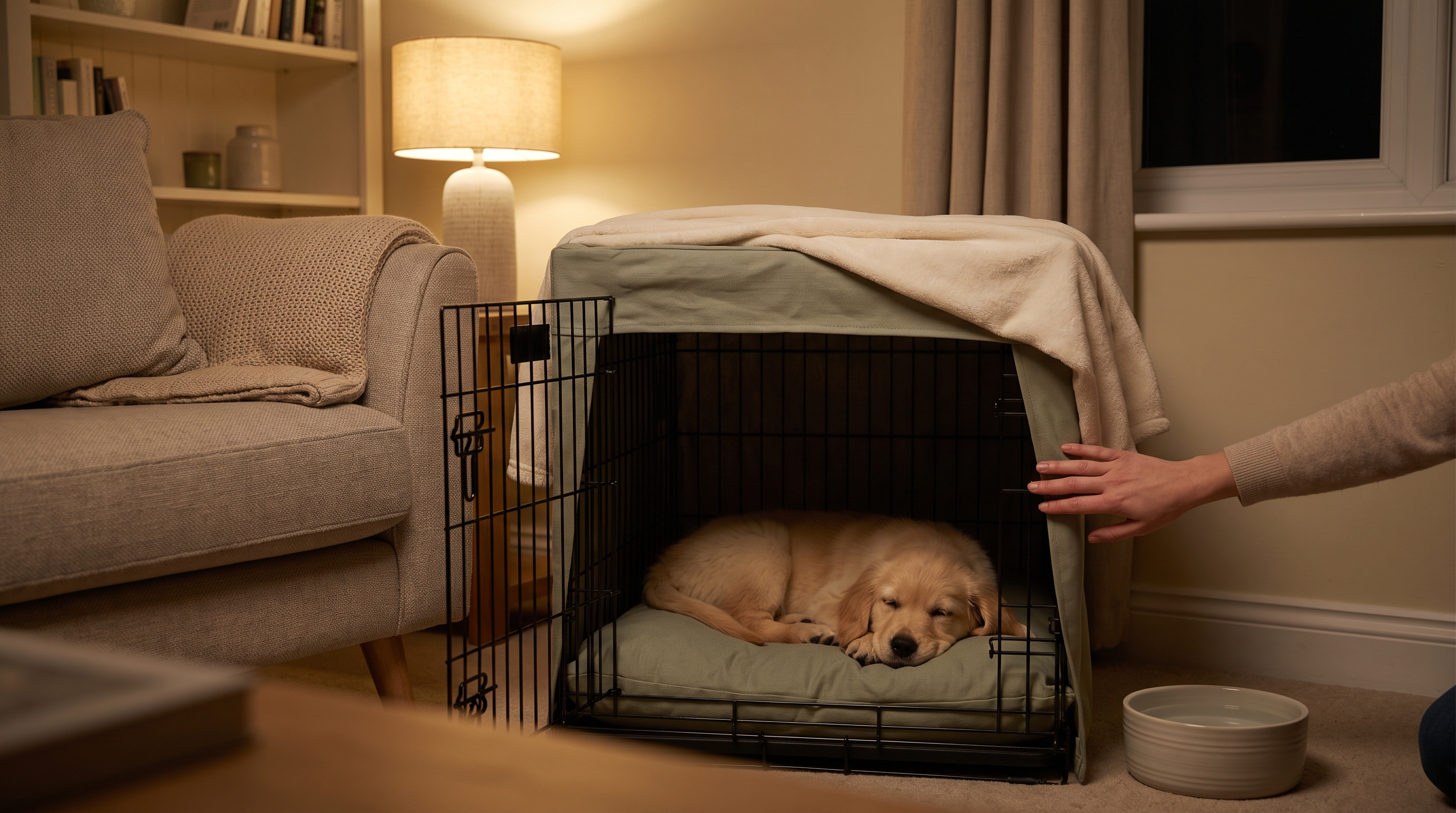
So it’s night one (or night five), you have a crate, a puppy, and a growing worry that nobody in this house is ever sleeping again. Here’s the short version: crate training a puppy at night works best when you put the crate where your puppy can sense you, empty their bladder right before bed, tire them out beforehand, keep the crate safe and simple, and respond calmly to early crying instead of turning it into a battle. Do those things, stay consistent, and most puppies settle within a couple of weeks.
The longer version is below, because the details are where the calm comes from. Let’s get you both some sleep.
Why Nighttime Is a Whole Different Ballgame
Your puppy might be a crate champion at noon and a tiny sobbing mess at midnight. That’s normal, and there’s a good reason for it.
During the day your house is full of noise, light, movement, and you. At night it goes dark and silent and still. For a puppy who just left everything they’ve ever known, that quiet feels alien. As the trainers at Indigo Dog Training put it, moving in with you is the biggest day of your puppy’s life so far. They’ve left their mum, their siblings, their safe humans, and the only home they’ve ever known.
And here’s the part that really tugs at your heart: your puppy has almost certainly never slept alone before. They’ve always slept in a warm pile of littermates. If something scared them, mum was right there. So a cozy bed and a snuggly toy, while lovely, don’t fully replace that feeling of “someone’s got me.”
That’s why night crying is so common. It doesn’t mean you’ve failed, and it doesn’t mean your puppy is broken. It means they’re a baby in a strange new place, doing the only thing they know how to do to say “I’m not sure I’m safe.”
Crate training is worth it anyway
The crate isn’t a cage. Done right, it becomes your puppy’s own little bedroom, a safe space that lowers stress instead of causing it.
It also helps house training in a clever way. Puppies naturally avoid soiling the spot where they sleep, so a properly sized crate encourages them to hold it and wait for a potty break. It keeps them safe when you can’t watch them, too. A snoozing puppy can’t chew the couch corner or find something dangerous on the floor.
The goal is a puppy who sees the crate as a good place. That pays off far beyond bedtime: vet visits, travel, and grooming all get much easier down the road.
The Night Crate Training Game Plan
Here are the moves that make nights easier, drawn from experienced trainers. Think of these as your checklist.
1. Put the crate in the right spot
Start the crate near you. For most new puppies that means in your bedroom, or just outside the door, where they can hear you breathe and smell that you’re close.
Being able to sense you is the difference between “I’m alone in the void” and “my people are right here.” Once your puppy is sleeping through the night reliably, you can move the crate a little at a time toward its permanent home if that’s the plan.
2. Be smart about food and water before bed
A full bladder at 2am helps nobody. Try to feed dinner with enough time before bed for digestion, and consider lifting the water bowl a little while before lights-out.
Two gentle warnings. Don’t leave your puppy thirsty, and don’t restrict water so hard that they’re uncomfortable. This is about timing, not deprivation. If you’re ever unsure, especially in warm weather, check with your vet.
3. Tire them out before bed
A puppy with leftover energy is a puppy who will absolutely let you know about it. A bit of play and gentle activity in the evening helps burn off the zoomies so sleep comes easier.
The trick is timing. You want tired, not wired.
4. Time the potty break for right before sleep
This one is huge for both sleep and house training. Take your puppy out to pee immediately before you put them in the crate for the night. Not twenty minutes before while you brush your teeth. Right before.
An empty bladder buys you the longest possible stretch before the first wake-up.
5. Don’t rev them up close to bedtime
Big, exciting, chase-the-toy games right before the crate can backfire. So can a huge emotional goodbye. Keep the last stretch of the evening calm and low-key so your puppy drifts down instead of spiking back up.
Boring is the goal. Boring is beautiful at 10pm.
6. Make the crate comfy, but keep it safe
Soft bedding, a familiar-smelling toy, and a crate that’s the right size all help a puppy settle. Some owners use a heartbeat-and-warmth toy that mimics a littermate. As one trainer at Baxter & Bella notes, these “Snuggle Puppy” style toys copy the warmth and heartbeat of another pup and are often the same size as your puppy.
Here’s the safety part that a lot of advice skips. Your puppy is alone and unsupervised in that crate all night, so anything you leave in there has to be genuinely safe to leave with a chewer.
- Watch the chewing. Many puppies will gnaw at bedding, blankets, and soft toys. Swallowed fabric or stuffing is a real choking and intestinal-blockage risk, and a blockage can turn into an emergency. If your puppy chews their bedding, switch to tough, chew-resistant crate bedding or take it out at night and use just the tray. A slightly less plush bed beats a midnight vet trip.
- Skip anything that can come apart overnight, like toys with small pieces, squeakers a determined puppy could rip out, or anything smaller than they could swallow.
- A bare crate is fine. If your puppy is a shredder, an empty crate (or one with a chew-proof mat) is safer than a cozy one full of things they might eat. Comfort matters, but safety comes first.
A Snuggle Puppy toy can help, so pair it with the other steps rather than relying on it alone, and only leave it in unsupervised if your puppy isn’t trying to destroy it.
7. Take the collar off before bed
This is a small step that prevents a scary problem. Before your puppy goes in the crate for the night, remove their collar, ID tags, and any harness.
When a puppy is alone and moving around a crate, a collar or a dangling tag can snag on the crate bars, a gap, or a latch. That can twist tight and cause choking or strangulation, and nobody’s there to help. An unsupervised puppy is safest with nothing around their neck. Put the collar back on in the morning when you’re together again.
8. Don’t be too eager to slam the door
Rushing to lock a nervous puppy in can backfire. Let the crate feel like a good place first with treats, meals, and naps inside with the door open, so being shut in later isn’t a shock.
The crate should earn a happy reaction, not a panicked one.
Tired of guessing when your puppy needs to go? Puddle predicts the next break from their age and breed.
Get Puddle →The 2am Cry: Potty Break or “I Miss You”?
Here’s the question that keeps new owners up (literally): my puppy is crying, do I go to them or not?
The honest answer is that it depends on which cry it is, and telling them apart is a skill you build over the first couple of weeks. Trainer Heidi Atwood at Baxter & Bella describes it well. Puppies bark, cry, and scratch at the crate to get to their people, and it can look downright frantic. On top of that, their tiny bodies have tiny bladders, so they genuinely need to potty often.
So you’ve got two different messages coming through the same sound: “I need to pee” and “I want to be with you.” It helps to remember that, as the AKC’s guide to canine communication explains, dogs whine and cry for lots of different reasons, and learning your own puppy’s sounds is a skill you sharpen over time.
How to read the two cries
The potty cry often comes after your puppy has been asleep, then suddenly wakes and gets urgent or restless. It tends to have a “something’s wrong, help” quality and won’t settle.
The company cry often starts the moment you leave, before they’ve slept at all, and has more of a protest rhythm to it.
You won’t nail this on night one, and that’s fine. When in doubt with a brand-new puppy, err on the side of a potty break. A missed potty signal means an accident and a setback. A quick trip outside costs you a few minutes.
How to handle a genuine night potty break
Keep it boring on purpose. Lights low, no chatter, no playtime. Carry or lead them out, let them go, give calm praise, then straight back to the crate.
You’re teaching them that nighttime potty trips are quick and business-only, not a party. Make it fun and you’ll get requested for the 3am social hour every night.
When crying might be a health issue, not training
Most night crying is normal. But sometimes a puppy’s body, not their feelings, is the problem, and that’s a vet call, not a training fix.
Call your vet if you notice any of these:
- Straining to pee, or squatting over and over with little or nothing coming out.
- Blood in the urine, or urine that looks cloudy or has a strong new smell.
- Only tiny drops each time, or a puppy who suddenly can’t hold any urine at all.
- Signs of pain, like crying while peeing, or a puppy who seems unwell, lethargic, or off their food.
Those can point to a urinary tract infection or another medical issue that no amount of scheduling will solve. When a housebroken-ish puppy suddenly can’t hold it, or a young one seems genuinely uncomfortable, trust your gut and get them checked. Better a “nothing’s wrong” visit than a missed infection.
The gentle shift over the first weeks
Early on, comforting a scared, tiny puppy is the right call. Indigo Dog Training is blunt about it: if your puppy is crying right now, go comfort them, then come back and read the why.
As your puppy settles in and you’re confident their needs are met, you can start teaching that calm behavior gets your attention and fussing doesn’t. That means not making eye contact, talking, or rushing over for pure attention-seeking noise, while still always answering a real potty need. If the crying at night is really wearing you down, our full guide on what to do when crate training a puppy makes them cry walks through it step by step.
⏱️ Puddle predicts the next potty break from your puppy's age and breed, using the AKC "one hour per month of age" rule, trimmed for recent meals and water.
Try Puddle →How Long Can a Puppy Actually Hold It Overnight?
One of the most confusing parts of all this is a myth that trips up a lot of new owners, so let’s sort it out.
You’ve probably heard the AKC “one hour per month of age” guideline. An 8-week-old (2 months) can hold it roughly 2 hours, a 3-month-old about 3 hours, and so on. That’s a great rule for daytime planning.
But overnight is different. Puppies are asleep, their systems slow down, and they can usually stretch a bit longer at night than the daytime math suggests. So no, you don’t have to set an alarm every two hours if your puppy is sleeping through. Follow their actual signals.
Here’s the flip side, and it matters: very young puppies still need at least one middle-of-the-night potty break. Their bladders are tiny and control is still developing. Expecting a brand-new puppy to hold it all night, every night, sets you both up to fail.
The realistic timeline
Bladder control develops over months, not days. Most puppies aren’t reliable through the night until somewhere around 4 to 6 months, sometimes a little later. Some lucky owners get full nights sooner. Plenty don’t, and their puppies are completely normal.
So please, throw out the idea that a puppy should be “fully potty trained by 12 weeks.” That’s not how puppy plumbing works, and holding yourself to it just breeds frustration. If you want the bigger picture on timing, our puppy potty training schedule lays out what to expect week by week.
Build a routine they can predict
Puppies thrive on rhythm. Same bedtime, same last-potty spot, same calm wind-down, same wake-up. The more predictable the night, the faster it clicks. You can find a full example in our crate training schedule, and it pairs nicely with your daytime how to potty train a puppy plan. Tracking those overnight patterns is exactly the kind of thing the Puddle app is built to make easy.
Handling Accidents Without Losing the Plot
An accident in or near the crate is not a disaster, and it is definitely not your puppy being spiteful. Puppies don’t do revenge pees. An accident is a developmental, supervision, or timing hiccup, nothing more.
What actually works
Clean it thoroughly with an enzyme cleaner so no scent lingers to mark the spot as a bathroom.
Look at the timing. Did the last potty break happen too early? Was there water right before bed? Adjust the schedule, not the puppy.
Check the crate size. Too big and a puppy can pee in one corner and sleep in another. It should be just big enough to stand, turn around, and lie down.
What to never do
Never rub your puppy’s nose in a mess. Never scold or punish them for an accident. It’s one of the most stubborn myths out there, and it’s flat wrong.
Punishment doesn’t teach a puppy where to go. It teaches them that you’re scary and that peeing near you is dangerous, which often makes them hide to potty and slows house training down. Reward-based methods win, every time. Catch them doing it right, celebrate like they just won an award, and you’ll get there faster. A cheerful “good potty!” and a treat outside does more than any amount of frustration ever could. When you’re tracking things in Puddle, it’s easy to spot the pattern behind an accident instead of blaming the pup.
When accidents might mean a vet visit
One more time, because it’s important: most accidents are a schedule or supervision issue. But if the accidents come with straining, blood in the urine, constant dribbling, or a puppy who genuinely can’t hold anything, that’s a health flag, not a training flag. A sudden jump in accidents in a puppy who was doing well is also worth a vet chat. When your puppy’s body is the problem, no schedule tweak will fix it, so let your vet rule out an infection or other issue.
A Sample Peaceful-Night Routine
Every puppy is different, but here’s a simple flow that ties the steps together. Adjust the clock to your household.
- Evening: feed dinner with time to spare before bed, then some gentle play to burn energy.
- Wind-down: lift the water bowl a while before bed, and keep the last hour calm and quiet.
- Last call: take your puppy out for a potty break right before the crate, with calm praise when they go.
- Crate prep: take off the collar, tags, and harness, and check the bedding is chew-safe (or leave it out for a shredder).
- Into the crate: cozy but safe setup, a familiar-smelling toy if it’s not a choking risk, crate near you. Lights out.
- If they cry: decide potty or company. When unsure with a young puppy, do a quiet, boring potty trip, then back to bed.
- Middle of the night: expect at least one potty break for young puppies, and keep it business-only.
- Morning: collar back on, then straight outside to potty the moment they wake, with big happy praise.
Repeat it every single day. Consistency does more than any gadget or trick. Within a week or two, most puppies start stretching their sleep and settling faster.
Hang in there. The 2am wake-ups feel endless while you’re in them, and then one morning you realize you slept the whole night. It comes faster than it feels like it will.
Frequently Asked Questions
Should I ignore my puppy crying in the crate at night?
Not with a brand-new puppy. Early on, crying often means they need a potty break or feel scared and alone, so it’s fine to respond calmly. As they settle in over the first weeks, you can start teaching that quiet gets attention and fussing doesn’t. Learn your puppy’s real “I need to pee” cry versus the “I want company” cry.
How long can a puppy hold its bladder overnight?
Less than you’d hope at first. Very young puppies usually need at least one middle-of-the-night potty break. Bladder control builds over months, and most puppies aren’t reliable through the night until around 4 to 6 months. The daytime “one hour per month of age” rule is stricter than what they can hold while asleep.
Where should I put the puppy’s crate at night?
Somewhere they can sense you. A new puppy has just left its mum and littermates, so being totally alone in a dark, quiet room is scary. Many owners start the crate in or near the bedroom, then slowly move it to its final spot once the puppy is settled.
Should I give my puppy water before bed?
Be thoughtful about it. Lifting the water bowl a little while before bedtime and timing a potty break right before sleep can cut down on overnight accidents. Never restrict water to the point your puppy is thirsty, and ask your vet if you’re unsure, especially in hot weather.
Should my puppy wear a collar in the crate at night?
No. Take the collar, tags, and any harness off before your puppy goes in the crate for the night. When a puppy is alone and unsupervised, a collar or tag can catch on crate bars or gaps and cause a dangerous choking or strangulation risk. A naked, snoozing puppy is the safest puppy.
When is night crying or accidents a reason to call the vet?
Most night crying is normal puppy stuff, but some signs point to a health issue, not a training one. Call your vet if your puppy is straining to pee, producing only small drops, has blood in their urine, seems to be in pain, or genuinely can’t hold any urine at all. Those can signal a UTI or other medical problem that training won’t fix.
Track It With Puddle
The hardest part of crate training a puppy at night is timing that last potty break and knowing when the next one is really due, which is exactly what Puddle handles for you. It uses your puppy’s age and breed with the AKC “one hour per month of age” rule, trimmed for recent meals and water, to show a live countdown to the next break on the Today screen, plus one-tap logging and overnight reminders with quiet hours so you’re never guessing at 2am. It’s all free for your first puppy, and if you want Puddle to learn your puppy’s actual overnight holds, Pro’s Smart Schedule personalizes those predictions even further.