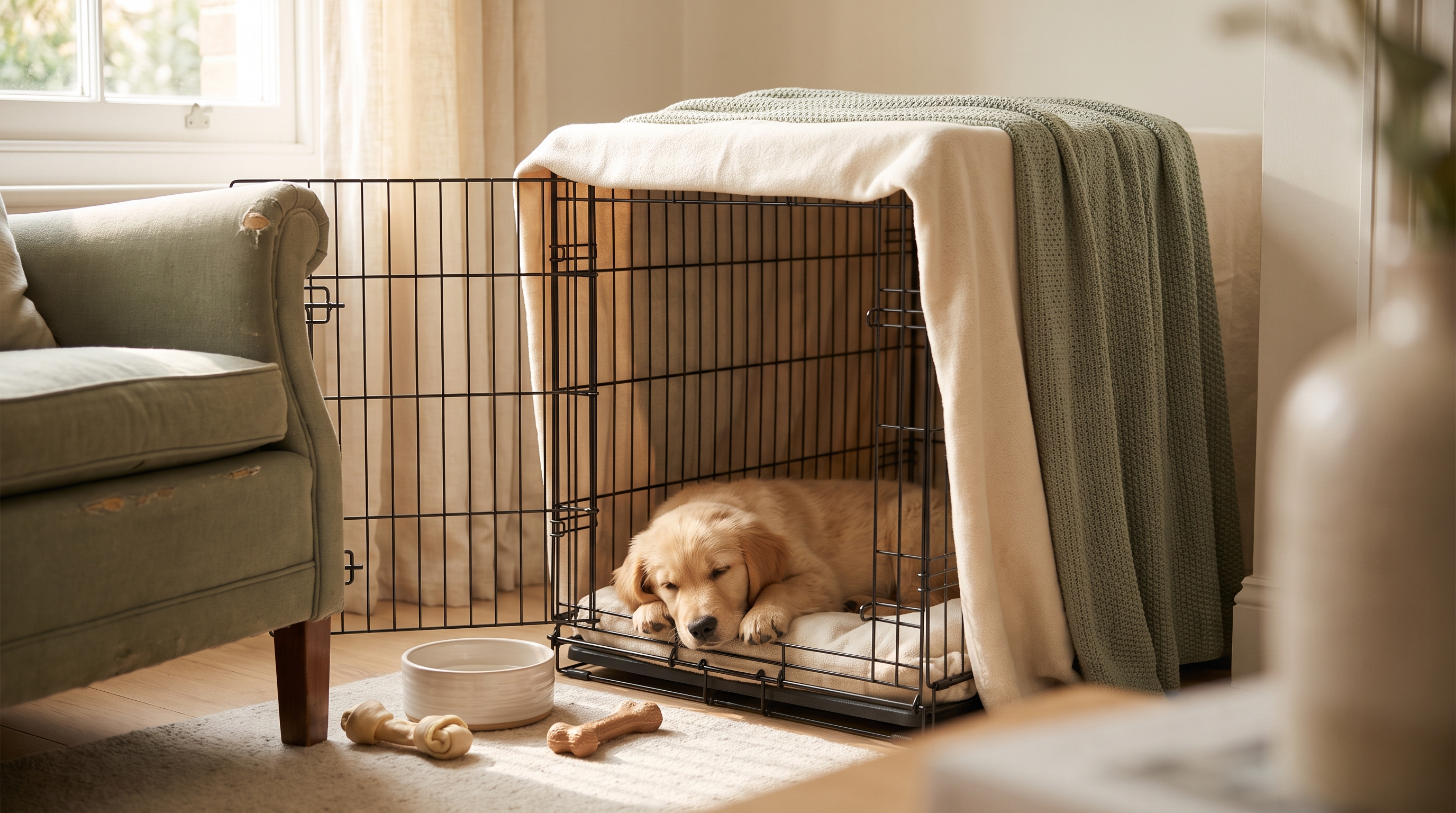
If you’re crate training a puppy crying like her heart is breaking every time you shut the door, take a breath. This is one of the most normal, most universal parts of getting a new puppy. Crate crying almost always means one of two things: she genuinely needs something (usually a bathroom break), or she’s protesting being alone for the first time in her short life. Your job is to tell those two apart, meet the real need fast, and calmly ignore the protest.
It’s uncomfortable to listen to. It’s also a normal, temporary part of crate training for most puppies when you handle it consistently. A quick note first: most of what’s below comes from experienced dog trainers and breeders who’ve talked new owners through this exact moment, sharing routines that work in real households. That’s useful, but it isn’t the same as veterinary guidance. Where bladder limits, choking, or safety are involved, we’ll flag it clearly and point you toward your vet rather than treat a trainer’s tip as medical fact.
Why Your Puppy Is Crying in the Crate
Put yourself in her paws for a second. A few weeks ago, she was piled up with her littermates, never alone, never quiet. Now she’s in a new house, in a box, by herself. Of course she’s upset.
This isn’t a sign you’re doing something wrong. It’s a sign she’s a puppy who’s never had to be calm and alone before, and that’s a skill, not something dogs are just born knowing. Dog trainer Kristen Cameron, who writes about puppy behavior at Find Your Balance Dog Training, makes a point worth sitting with: too many puppies spend every waking moment glued to a person, getting endless attention, and never get the practice of being okay on their own. Then one day the owner has to leave for work, and the puppy who’s never sat quietly by herself completely falls apart. That’s often where separation anxiety starts. This lines up with what trainers generally understand about dogs needing practice being alone, though it isn’t a formal medical diagnosis.
Crate training, done right, is the fix for that problem, not the cause of it. It teaches her that alone time is safe, boring in a good way, and always temporary.
Is “Cry It Out” Really the Only Option?
Short answer: mostly, yes, but with a big caveat. In a published Q&A where a new owner asked this exact question, a dog trainer’s answer was direct: you do let a puppy cry it out, but there’s a right way and a wrong way to do it. Take this as one experienced trainer’s practical approach rather than an official standard. It’s a reasonable, humane way to handle protest crying, and it matches what other trainers describe, but it’s not a veterinary or kennel-club rule.
The wrong way is to just shut the door and let her scream indefinitely with no plan. The right way starts before the crying even happens, and it always leaves room for the times crying really does mean “I need out.”
Rule Out a Real Need First
Before you assume it’s just protest, make sure your puppy doesn’t need to go out. The advice here mirrors basic house-training logic: control the food and water, and you control when your puppy needs a bathroom break.
That means:
- Puppy goes potty right before going into the crate, every time.
- You know roughly when she last ate or drank, so you’re not guessing.
- You’re not crating her right after a big drink of water or a meal.
If you’ve done that and she’s still crying, you’re very likely looking at protest crying rather than an urgent need. If you have any doubt about timing, a potty schedule built around her age takes the guesswork out of it.
That handles the setup, before she’s even in the crate. The harder part is mid-session, once she’s already crying and you’re not sure which kind it is.
Protest Crying vs. a Real Need: How to Tell Mid-Session
Here’s where two pieces of advice can sound like they contradict each other: “never open the door while she’s crying” and “let her out for a real need.” They don’t conflict, once you know which situation you’re in.
It’s probably protest crying if: you’re early in the session, she went potty right before going in, and it hasn’t been long since her last meal or drink. In this case, don’t open the door while she’s mid-cry. Opening the door right when she’s crying the loudest teaches her something you don’t want her to learn: cry loud enough, and the door opens. Instead, ignore it completely, pretend to be busy, and the moment she goes quiet, even for a few seconds, mark that with a calm word of praise or a treat, then open the door.
It’s probably a real need if: she’s been in the crate close to or past the time she can realistically hold it for her age (the AKC’s well-known guideline of roughly one hour per month of age is a reasonable starting point), or her crying suddenly shifts in tone, more frantic, more persistent, different from the usual settling-in fuss. In that case, let her out. Don’t make her “earn” the door by going quiet first. A puppy who has to go isn’t going to calm herself down on command, and waiting her out just risks an accident and real, unnecessary distress. When you do let her out for a real need, keep it low-key: a calm trip outside, not a big excited greeting, so you’re meeting the need without accidentally throwing a party for the crying itself.
The short version: early and well within her limit, wait out the fuss. Late, past her limit, or clearly different, let her out. Timing and context are what tell you which one you’re dealing with, not just the volume of the crying.
Tired of guessing when your puppy needs to go? Puddle predicts the next break from their age and breed.
Get Puddle →One More Safety Must: Take Off the Collar
Before your puppy goes into the crate, take off her collar, leash, and anything with tags or loops. It’s an easy step to forget in the middle of a crying puppy and a busy morning, but it’s basic crate safety that trainers and vets widely agree on: collars and dangling tags can snag on crate wires or bars, and if that happens while she’s unsupervised, it’s a real strangulation risk.
If you’re worried about being able to grab her quickly without a collar on, ask your vet about a breakaway collar for the rest of the day. That’s a safer option than leaving a standard collar on during crate time, and your vet can help you size one correctly.
Make the Crate Worth Going Into
Every crate session should come with something good waiting inside. Pomsky breeder Kim Baumann shares a routine along these lines in her club’s crate training write-up (this reflects one breeder’s own practice, not a veterinary standard, but the underlying idea, that the crate should feel good, is basic reward-based training). A few ways to build that positive association include:
- A favorite toy or a frozen stuffed Kong that only comes out for crate time, so it feels special rather than routine.
- Meals fed inside the crate, door open at first, so the crate becomes “the place good things happen,” not just a holding pen.
- A snuggle toy that mimics warmth or a heartbeat, which can help take the edge off being away from her littermates for the first time.
One more safety note, worth confirming with your vet if you’re unsure: check any chew toy or stuffed Kong before you hand it over, and size it so she can’t bite off and swallow a piece. Choking is a genuine risk with any unsupervised chew, so if you’re leaving her with one during a longer, less-supervised stretch, glance in on her when you can, especially the first few times you try a new chew.
The 2:1 Rule: Rest Matters More Than You Think
A lot of new owners get this backwards. It’s tempting to think a puppy who’s had a huge, tiring play session should be nice and sleepy in the crate. But trainer Kristen Cameron recommends a 2:1 ratio as a rule of thumb, not a hard science: for every one hour of active, supervised time out of the crate (think short training sessions, walks, play), your puppy gets about two hours of rest in the crate.
That rest doesn’t have to mean sleeping the whole time. Calm and awake counts too. Puppies need that downtime to process what they just learned and recharge, the same way a toddler needs a nap even after a “good” morning.
If your puppy is still worked up when you put her in the crate, even after what felt like hours of play, she might not be tired yet, she might be overstimulated. An overstimulated puppy cries harder, not less, right after activity. Building in true wind-down time before crate sessions can make a real difference.
Setting Up the Crate to Help
A crate that feels like a bare metal box isn’t doing your puppy any favors. Every Dog Austin, a dog training and behavior resource, lays out a few setup steps that go a long way:
- Right-sized crate. She should be able to stand up, turn around, and lie down comfortably. Too big and it stops feeling den-like; too small and it’s just uncomfortable.
- Comfy bedding. A blanket or bed she actually wants to lie on.
- A quiet spot, at first close to you. In the early days, keep the crate in your bedroom where she can see or sense you nearby. After a few weeks, you can gradually move it toward wherever you want it long term.
- Cover part of the crate, not all of it. A blanket over the top and part of the sides can make it feel more like a den and block out visual distractions. Leave at least one side uncovered for airflow, and keep the crate away from heating vents, radiators, or direct sun so she doesn’t overheat, especially if you’re also using a warmth-feature snuggle toy.
- White noise or soft music. This can help mask outside sounds that might otherwise set off a fresh round of crying.
None of this eliminates crying entirely, especially in the first few nights. But it stacks the odds in your favor.
Building Up Crate Time, Step by Step
Once your puppy is comfortable wandering in and out of an open crate on her own, you can start layering in actual closed-door time. The general approach:
- Start with the door open. Let her go in and out at her own pace, rewarding any interest with treats and praise.
- Add a verbal cue. Something like “Kennel” or “Crate,” paired with a tossed treat, so she starts to associate the word with going in.
- Close the door briefly. Once she’s relaxed going in on cue, close the door for just 15 to 30 seconds while you stay nearby, then open it while she’s calm.
- Stretch the time slowly. Extend those short stretches bit by bit, always opening the door on calm behavior, not on crying.
- Step out of the room. Once she’s solid with you nearby, start leaving the room briefly, then coming back to let her out while she’s settled.
- Make it routine. Meals, naps, and quiet chew time in the crate, every day, so it stops feeling like a special ordeal and starts feeling like normal life.
As you stretch out those closed-door sessions, keep her age in mind. The AKC’s general guideline is that a puppy can hold her bladder for roughly one hour per month of age, so an 8 to 10-week-old puppy may only manage a couple of hours before she needs a break, not a full unsupervised stretch of several hours. Pushing past what she can physically hold isn’t a training win. It just sets her up for an accident and, honestly, unnecessary stress and discomfort for both of you. If you ever notice straining, unusual frequency, or accidents that seem out of character for her age, that’s worth mentioning to your vet rather than assuming it’s a training gap. Build toward longer stretches gradually as she gets older and her bladder control catches up.
⏱️ Puddle predicts the next potty break from your puppy's age and breed, using the AKC "one hour per month of age" rule, trimmed for recent meals and water.
Try Puddle →This is exactly where knowing your puppy’s real potty timeline helps you plan crate sessions that don’t fight against her bladder. If you’re guessing at when she last went versus when she’s likely to need another break, you’re more likely to crate her right before she really has to go, which turns into legitimate distress crying instead of protest crying. Tools that estimate her next likely bathroom break, based on her age and breed, take a lot of that guesswork out of scheduling crate time.
Nighttime Crying vs. Daytime Crying
A lot of puppies do better at night than during the day. In the same trainer Q&A referenced earlier, one new owner described her 9-week-old sobbing immediately when crated during the day, even after hours of play, but settling more easily and crying herself to sleep at night.
That’s a pattern trainers describe often, though it isn’t universal. Nighttime tends to come with a calmer household, a tired puppy, and a more predictable routine, all of which help. Daytime crating can be harder because there’s more going on, more reasons to feel like she’s missing out, and less natural sleepiness.
If daytime crying is your bigger struggle, lean harder into short, well-timed sessions built around her actual potty schedule, with something good waiting inside every time, rather than one long stretch.
When Crying Might Be Something Else
Most crate crying is a training issue, not a health issue. But it’s worth knowing the difference, and this is exactly the kind of question your vet, not a trainer’s blog or this article, is best placed to answer. If your puppy’s crying is paired with things like vomiting, diarrhea, unusual lethargy, straining to go, or she seems to be in physical pain rather than just upset, that’s a conversation for your vet, not something to train through. When in doubt about anything that seems off physically, a quick call to your veterinarian is always the right move.
A Few Things That Won’t Help
It’s worth saying clearly: rushing in every single time she cries, letting her out mid-tantrum for protest crying, or getting frustrated and raising your voice will all work against you. Neither will crating her longer than she can physically hold it and hoping she “gets used to it,” since that just teaches her that soiling the crate is unavoidable. None of this is about your puppy being “bad” or stubborn, she’s not being spiteful, she’s a baby animal learning a brand-new skill. Consistency, realistic timing, and calm, boring non-drama on your part are what get you there.
Frequently Asked Questions
Should I let my puppy cry it out in the crate?
It depends on why she’s crying. If she just went potty and hasn’t had food or water in a while, ignore the fussing and wait for a quiet pause before opening the door, so you’re not teaching her that crying opens it. But if she’s been in the crate longer than she can realistically hold it for her age, or the crying feels urgent, let her out calmly even if she’s still crying.
How do I know if my puppy is crying because she needs to potty or is just protesting?
You can’t always tell from the sound alone. Track when she last ate, drank, and went potty, and how long she can typically hold it for her age. If a break happened recently and she’s well within that window, it’s more likely protest. If she’s pushing past that window, treat it as real and let her out calmly.
How long should a puppy cry before I step in?
There’s no universal number. For protest crying, the general approach is to ignore the fussing rather than clock-watch, and open the door only once she’s settled, even briefly. But never make her hold it past what her bladder can physically manage, roughly one hour per month of age as a starting guideline from the AKC. Past that point, let her out even if she’s still crying.
Is crate training cruel?
No, not when it’s done with positive associations, appropriate sizing, and a gradual buildup of time. A well-run crate becomes a safe den your puppy chooses to use, not a punishment.
Where should the crate go for a new puppy?
In your bedroom for the first few days or weeks, so she can sense you’re close, and then move it gradually to its permanent spot once she’s more settled. Wherever it is, make sure it’s away from heating vents or direct sun so it doesn’t get too warm.
Is it safe to leave a collar on my puppy in the crate?
It’s safer to take it off. Collars, tags, and harnesses can catch on crate wires or bars, which is a real strangulation risk if she’s unsupervised. Remove her collar before she goes in, and if you’d rather not have her go collar-less, ask your vet about a breakaway collar for the rest of the day.
Track It With Puddle
Crate crying gets a whole lot easier to read once you actually know where your puppy is in her potty cycle instead of guessing. Puddle predicts her next likely bathroom break for free, using her age and breed alongside recent meals and water, and shows a live countdown right on the Today screen, so you can time crate sessions around a real need instead of second-guessing every whimper. Log pees, poops, accidents, meals, and water in one tap, and keep an eye on her 14-day accident trend and accident-free streak, all part of the free tier. If you want the prediction to learn her actual holds over time, Puddle Pro is a one-time $6.99 unlock, no subscription, that also adds the accident heatmap, a home screen widget, and support for up to four puppies.