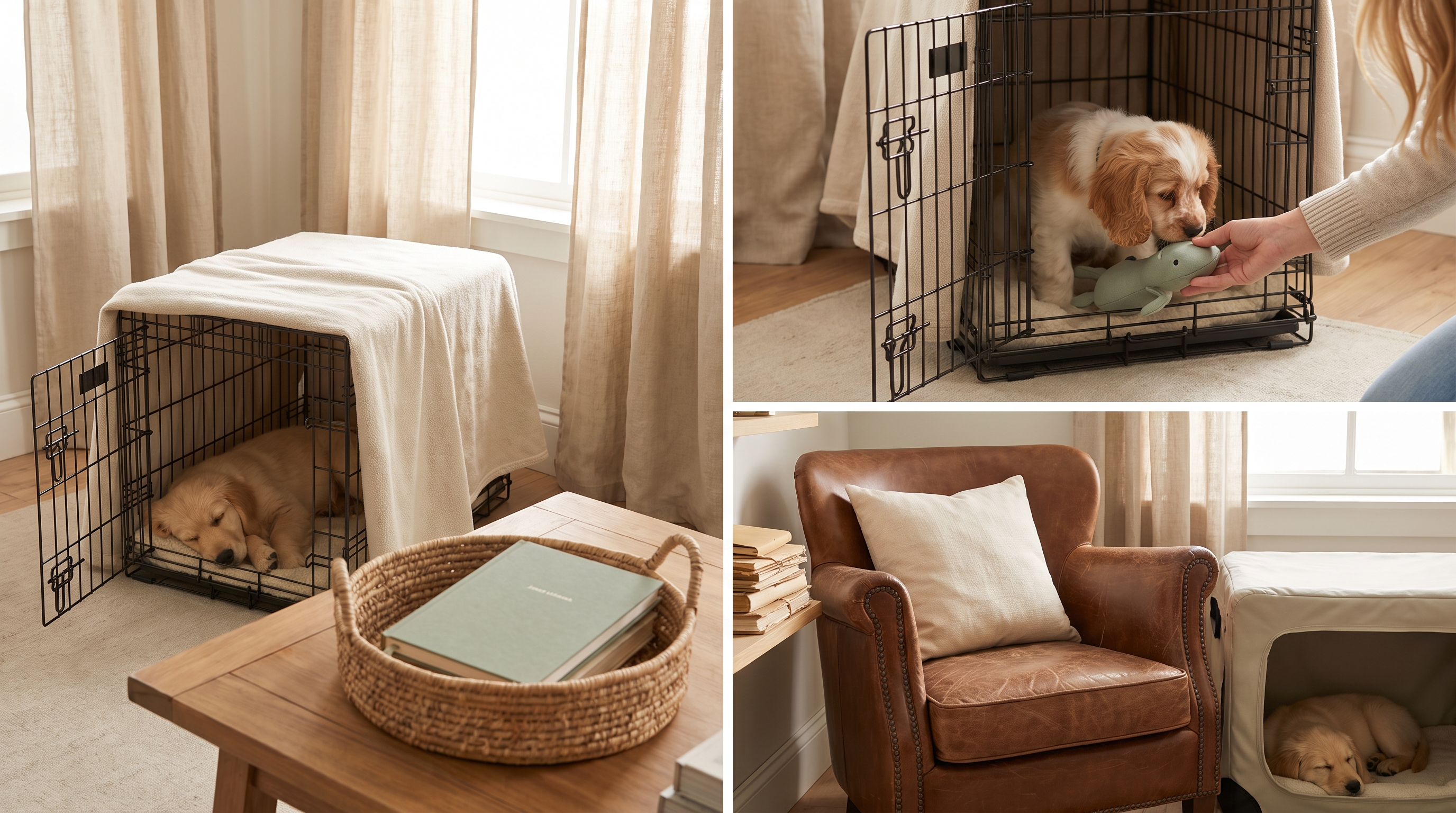
Here’s the short version. A good crate training a puppy schedule follows one simple loop all day long: potty, then play or training, then a meal or water, then a potty break again, then crate rest. Repeat. You anchor the day around sleep and bathroom breaks, and you always let your puppy empty out before they go in the crate.
That’s it. The crate isn’t a cage or a punishment. It’s the quiet room where your puppy learns to rest, and rest is what makes everything else click. A well-rested puppy learns faster and listens better. Below you’ll find copy-ready schedules broken down by age, plus overnight and household versions, safe setup basics, and fixes for the usual 2am chaos.
Why a Schedule Matters More Than the Crate Itself
Plenty of people buy a crate and expect it to do the work. It won’t. The magic is in the rhythm around it.
Trainers at Keen Dog Training call crate scheduling one of the first things they dial in with every client. Their reasoning is simple: a well-rested dog learns faster and listens better, so the daily rhythm is what everything else gets built on.
Think of it like a toddler’s nap schedule. Skip the naps and you get a cranky, wired little creature who can’t focus and has accidents everywhere. Keep the naps steady and life gets calmer for everyone.
The other reason a schedule matters is safety. Carver Street Animal Hospital puts it plainly: leaving a puppy loose to wander, chew, and maybe hurt itself is far more inhumane than confinement. When you can’t watch your puppy, the crate keeps them safe and out of trouble. Crate training is neither cruel nor unfair when it’s done right.
The core loop, spelled out
Every good schedule is just this loop on repeat:
- Potty break. First thing after any nap, meal, or play session.
- Active time. Play, a short training game, a walk, or supervised house time.
- Food or water at set times, not free-for-all grazing.
- Another potty break before the crate. Empty puppy, happy crate.
- Crate rest. Sleep and decompression.
One trick from Keen Dog Training: plan rest to follow active time. Your puppy is far more likely to settle and sleep if you’ve worked their body or brain right before crate time. A tired puppy goes in the crate and sighs. A bored puppy goes in and screams.
Set the Crate Up Safely First
Before you run any schedule, get the crate itself right. A safe setup does half the work, and a few of these are genuine safety issues, not nice-to-haves.
Get the size right. The crate should be big enough for your puppy to stand up, turn around, and lie down comfortably. That’s the standard. Too small and it’s uncomfortable and cramped. Too big and a young puppy will happily use one end as a bathroom, which undoes your potty training. Many crates come with a divider so you can grow the space as your puppy grows.
Take the collar off. This one matters. Remove your puppy’s collar, ID tags, and harness before they go in the crate. A dangling collar or tag can catch on crate wires, slats, or a latch, and a stuck puppy can panic or, worse, strangle. It sounds paranoid until you’ve seen a tag hook a wire. A naked puppy in the crate is a safer puppy.
Keep it cool and airy. Place the crate somewhere with good airflow, out of direct sun and away from heat vents or space heaters. Puppies can overheat in a confined space, and a crate draped in blankets on a warm day can turn stuffy fast. Aim for a calm, well-ventilated spot in the house where your puppy still feels near the family.
Watch what goes inside. More on bedding and toys in the overnight section, but the rule is simple: if your puppy can shred it, chew chunks off it, or swallow bits of it while you’re not watching, it doesn’t belong in the crate unsupervised.
Nail these four and the crate becomes exactly what it should be: a safe, cozy den.
How Long Can a Puppy Actually Hold It?
This is the number everyone wants.
A common guideline is one hour per month of age between potty breaks during the day, while your puppy is awake and active. An 8-week-old (2 months) tops out around two hours. A 3-month-old, about three hours. And so on, up to a normal adult limit.
A few honest caveats:
- This is a ceiling, not a goal. Younger puppies often need breaks much sooner, especially after eating, drinking, playing, or waking up.
- Overnight is different. Sleeping puppies can usually hold it longer than the daytime rule suggests, because their systems slow down. More on nights below.
- Don’t treat the daytime number as a challenge. If your puppy signals earlier, take them out.
A quick reality check on the finish line, too. Your puppy will not be fully potty trained at 12 weeks, no matter what your neighbor claims. Bladder control develops over months, and most puppies aren’t truly reliable until 4 to 6 months or older. Accidents in the meantime aren’t defiance. They’re just an unfinished body. If you want the full bathroom side of this, our puppy potty training schedule breaks it down by the clock.
Tired of guessing when your puppy needs to go? Puddle predicts the next break from their age and breed.
Get Puddle →Crate Schedules by Age
The one-hour-per-month rule shapes your whole day, because a puppy’s age sets how often you’re up and out. So here are three starter routines, one per stage. Find the one closest to your puppy’s age and adjust the clock to your life.
These are daytime templates. The overnight plan comes in its own section below, because nights follow different rules.
8-week-old puppy (about 2 months)
This is the tiniest-bladder stage. Expect to be out a lot, and expect crate naps to be short and frequent.
- Max daytime hold: around two hours awake, often less.
- Potty after every single thing: waking, eating, drinking, and playing. Set a timer for every one to two hours on top of that.
- Crate naps run short. A little play, then a nap, then straight outside. Rinse and repeat all day.
A sample block looks like this: potty, short play, breakfast, potty again, crate nap of an hour or two, then out the second they wake. Then repeat. At this age your puppy will also need at least one bathroom break in the night.
12-week-old puppy (about 3 months)
The stretches get a little longer and the day gets a little calmer. You’re still on a tight leash, but you can breathe more.
- Max daytime hold: around three hours awake.
- Crate naps lengthen. Two to three hour rest blocks between activity become realistic.
- Fewer emergency dashes, but still potty after every meal, nap, and play session without fail.
A sample block: potty, a walk or training game, a meal, potty, then a crate rest of two to three hours. Many puppies this age can drop to a single night break, though some still need two.
4-to-6-month-old puppy
Now you’ve got real breathing room. Bladders are bigger, control is better, and the day starts to look almost normal.
- Max daytime hold: roughly four to six hours awake, near an adult stretch.
- Longer, fewer crate sessions. Instead of constant naps, you get real work blocks and real rest blocks.
- Most puppies sleep through the night by this stage, though a late-evening last call still matters.
A sample block: potty, a solid chunk of play, training, and supervised house time, a meal, potty, then a longer crate rest while you get on with your day. Keep rewarding the right choices. Reliable is close, but it isn’t automatic yet.
Whatever the age, the loop underneath never changes. Potty, activity, food or water, potty, rest. You’re just spacing it out as your puppy grows.
Sample Schedule: The Work-From-Home or Stay-at-Home Day
Age sets the spacing. Your household sets the shape of the day. If you’re around all day, you’ve got the easiest setup and the sneakiest trap. The trap is skipping crate time because you feel guilty. Don’t. Keen Dog Training is clear that your dog should still spend time resting in the crate throughout the day even when you’re home. It prevents separation anxiety, guarantees real rest, and frees you up for tasks where you can’t supervise.
Here’s a sample day for a young puppy. Stretch the gaps to match your puppy’s age using the schedules above.
- 7:00 am First potty of the day, right away. Then a walk or some morning play.
- 7:30 am Age-appropriate house time. Tether your puppy to you while you make breakfast so they can’t wander off and pee behind the couch.
- 8:00 am Breakfast. Notice it comes a bit after wake-up, not the second their eyes open.
- 8:20 am Potty break after eating. Food moves things along fast in puppies.
- 8:30 am Crate rest. They just ate and played, so they’re ready to sleep.
- 10:30 am Potty, then play or a short training session.
- 11:30 am Potty, then crate rest again.
- Repeat the loop through the day, with lunch and water breaks folded in.
- Evening Dinner, a calm potty walk, family wind-down, last call outside, bedtime crate.
Notice the pattern. Nothing fancy. Potty, activity, food or water, potty, rest. The crate time isn’t punishment sprinkled in. It’s built-in recovery.
Why not feed the instant they wake up
Small thing, big payoff. If you serve breakfast the moment your puppy stirs, you teach them that waking equals food. So they start waking earlier and earlier, until you’ve got a furry alarm clock going off at 5am.
Keen Dog Training’s fix is easy: build a little buffer between wake-up and the first meal. Let them potty, stretch, and mooch around first. Then eat.
Sample Schedule: The Away-at-Work Day
Working outside the home doesn’t rule out crate training, but a young puppy can’t be crated for a full 8-hour shift. That breaks the one-hour-per-month rule and sets your puppy up to have an accident in the one place you don’t want one.
Options to bridge the gap:
- A midday visit. A dog walker, neighbor, or family member drops in for a potty break and a little play.
- A safe pen setup. Carver Street Animal Hospital notes you can dog-proof a small room or use an exercise pen with a barrier so your puppy has a safe zone plus a bathroom spot for longer stretches.
- Rotating rest spots. Keen Dog Training points out that tethering, an x-pen, or supervised “place” time can replace some crate time. You should still do some crate time daily, but these give you flexibility.
A workable away-day loop looks like this:
- Morning Potty, brisk walk or play, breakfast (after a short gap), potty again, then crate or pen before you leave.
- Midday A visit: potty, quick play, back to rest.
- Evening Potty the moment you’re home, dinner, real play and training, wind-down, final potty, bedtime crate.
The guilt is real, I know. But a puppy who gets a midday break and a big evening of connection does just fine. Consistency beats constant presence.
⏱️ Puddle predicts the next potty break from your puppy's age and breed, using the AKC "one hour per month of age" rule, trimmed for recent meals and water.
Try Puddle →The Overnight Crate Schedule
Nights follow different rules, so they get their own plan.
Young puppies usually can’t sleep all the way through at first. Very young pups, like the 8-week-olds above, typically need at least one bathroom break in the night. But here’s the good news: asleep, they can often hold it longer than the daytime one-hour-per-month math would suggest. Their bodies are idling.
A simple overnight routine:
- Wind down before bed. No wild zoomies right before the crate. A calm potty walk and a settle.
- Collar off. Same rule as daytime. Tags and collars come off before your puppy is left in the crate unsupervised for the night.
- Last call outside. Empty puppy, then straight into the crate. Skip the water buffet right at bedtime.
- Crate near your bed for the first stretch of weeks. This is huge for crying (next section).
- One quiet middle-of-the-night break for young puppies. Take them out with as little fuss as possible. No playing, no chatting, no treats party. Potty, praise softly, back to bed.
- Morning wake-up, then potty right away before anything else.
The boring-on-purpose night trip matters. If 3am is exciting, your puppy will request the 3am show every night. Keep it dull and they learn nights are for sleeping. As your puppy hits the 3-to-4-month range, that night break usually fades on its own.
Want the timing dialed in for your exact puppy? A tool like Puddle can predict the next break from age and breed so you’re not doing bladder math half-asleep.
Bedding and Toys: Cozy, But Chew-Safe
A soft crate feels kinder, and it can be. But an unsupervised puppy is a tiny wood chipper, and this is where cozy can turn dangerous.
Left alone, puppies chew. If they can rip up a blanket, gnaw stuffing out of a plush toy, or bite chunks off something soft, they can swallow those pieces. Swallowed fabric or stuffing can choke a puppy or cause an intestinal blockage, and a blockage is an emergency, not a training hiccup.
So keep the crate comfy but safe:
- Use chew-proof or puppy-appropriate bedding. If your puppy is a determined shredder, a tough, hard-to-destroy mat beats a fluffy blanket they’ll disembowel.
- Skip stuffed toys with squeakers or loose filling for unsupervised crate time. Save those for playtime when you’re watching.
- Choose sturdy, size-appropriate chew items that can’t be bitten into swallowable chunks.
- Check everything regularly. If a toy or blanket is starting to come apart, pull it. A frayed edge today is a swallowed strip tomorrow.
The goal is a den that feels safe and stays safe. A little less fluff is a fair trade for a puppy who can’t eat their bed.
Handling the Crying (Because It’s Coming)
Almost every new puppy cries in the crate, especially the first few nights. It is not a sign you’re doing something wrong. It’s a sign your puppy is a baby who just left everything they knew.
Veterinary behaviorist Dr. Wailani Sung explains that puppies cry when they’re distressed, the same way they’d call out for their mother if they got separated. It’s communication, not manipulation. The Royal Kennel Club echoes this: new puppies cry because they feel lonely after leaving their mother and littermates, and that homesickness fades as they bond with you and learn the new routine.
What actually helps:
- Keep the crate close at night. The Royal Kennel Club suggests sleeping nearby for the first few nights, even resting a hand near the bed, so your puppy learns they’re not alone.
- Rule out real needs first. A crying puppy might genuinely need to potty, or be hungry, since little tummies empty fast. Check the obvious stuff before assuming it’s just protest.
- Tire them out beforehand. Back to that golden rule: rest follows activity. A puppy with a full brain and body settles faster.
- Add safe comfort. Chew-safe bedding or a sturdy, puppy-appropriate toy can make the crate feel less lonely. Just keep it to items your puppy can’t shred and swallow while you’re not watching.
One thing to skip entirely: punishment. Never scold or scare your puppy for crying or for accidents. Dr. Sung stresses using positive reinforcement to teach puppies what you want without frightening them. Fear doesn’t build a calm crate. It builds a puppy who’s scared of the crate.
If the crying is really testing you, we wrote a whole gentle guide on crate training a puppy that’s crying. You’re not alone at 2am. Promise.
When It’s a Vet Problem, Not a Schedule Problem
Most crate and potty bumps are training. Some are health. Knowing the difference protects your puppy, so keep this short list in the back of your mind.
Call your vet, don’t just tweak the routine, if you notice:
- Your puppy can’t urinate, or strains and produces little or nothing.
- Blood in the urine, or obvious pain while going.
- Persistent diarrhea, especially with vomiting, low energy, or signs of dehydration.
- Extreme, unrelenting distress in the crate that doesn’t ease with any of the normal comfort steps, or crying paired with looking genuinely unwell.
These aren’t stubbornness or a scheduling gap. They can signal a urinary problem, a stomach bug, or something that needs real veterinary care. A puppy who suddenly can’t pee is an emergency, full stop. When in doubt, a quick call to your vet beats guessing. I’m the maker of a puppy app, not a vet, and neither of us can diagnose your dog through a schedule.
Common Crate Schedule Mistakes to Avoid
A few traps catch nearly every first-timer. Sidestep these and you’re ahead.
Crating too long for the age. Stretching past the one-hour-per-month daytime limit sets your puppy up to fail. If you can’t be there, arrange a break or a pen.
Leaving the collar on. Tags and collars come off before the crate. It takes two seconds and removes a strangulation risk.
Skipping the pre-crate potty. Always let your puppy eliminate before they go in. Carver Street Animal Hospital frames good scheduling as making sure the pet has had a chance to play, eat, and eliminate before confinement. Empty puppy, calm crate.
No rest before rest. Tossing a wired puppy into the crate and hoping they nap. Work them first, then crate.
Feeding at wake-up. Creates the early-morning alarm-clock puppy. Add a buffer.
Treating accidents as defiance. They aren’t spite. They’re a developmental and supervision issue. Rubbing a nose in a mess or yelling teaches fear, not bladder control, and it slows everything down. Reward the right choices instead. Our full how to potty train a puppy guide leans hard on the reward-based approach that actually works.
Using the crate as punishment. The crate is a bedroom, not a timeout. If it becomes the “bad place,” you lose your best training tool.
A Note on Adjusting for Your Puppy
Every schedule here is a starting point, not a law. Breeds differ. Individual puppies differ. A tiny toy breed and a giant breed puppy won’t share the exact same bladder timeline, and your own puppy will surprise you both ways.
Watch your puppy, not just the clock. If they signal early, believe them. If they’re clearly holding longer with no accidents, you can gently stretch things. The goal is a routine steady enough to feel safe and flexible enough to fit real life.
And keep the long view. A puppy who isn’t reliable at 12 weeks is completely normal. Track the trend over weeks, not the single bad Tuesday. Tracking your puppy’s real patterns with something like Puddle makes it much easier to see progress you’d otherwise miss.
Frequently Asked Questions
How long can a puppy stay in a crate during the day? A rough guide is one hour per month of age between potty breaks while awake, so a 3-month-old maxes out around three hours. Always give play, food, and a potty break before crate time, and never use the crate as all-day storage.
Should I put my puppy in the crate even when I’m home all day? Yes. Trainers recommend some crate rest during the day even for work-from-home owners. It builds independence, helps prevent separation anxiety, and makes sure your puppy actually sleeps instead of running on empty.
Should my puppy wear a collar in the crate? No. Take off collars, tags, and harnesses before crating. A dangling collar or tag can catch on crate wires or slats, and that’s a real strangulation hazard. A naked puppy in the crate is a safer puppy.
Why does my puppy cry in the crate at night? New puppies often cry because they feel lonely after leaving their mother and littermates. For the first few nights, place the crate near your bed. Most crying settles as your puppy learns the routine feels safe.
When should I call a vet instead of adjusting the schedule? Call your vet if your puppy can’t urinate, strains to go, has blood in their urine, has persistent diarrhea, or is in extreme, unrelenting distress. Those are health flags, not training problems, and they need a professional, not a schedule tweak.
When will my puppy be fully potty trained? Later than most people expect. Bladder control develops over months, and many puppies aren’t reliable until 4 to 6 months or older. A 12-week deadline is unrealistic, so keep the routine steady and expect some accidents.
Track It With Puddle
A crate schedule only works when the potty breaks land at the right time, and that’s exactly what Puddle takes off your plate. The free Today screen uses your puppy’s age and breed, with a sensible hold-time rule trimmed by recent meals and water, to show a live countdown to the next break, so you always know when to open the crate before an accident happens. Log each pee, poop, meal, and water in one tap, watch your accident-free streak grow, and let the countdown handle the timing while you handle the puppy.