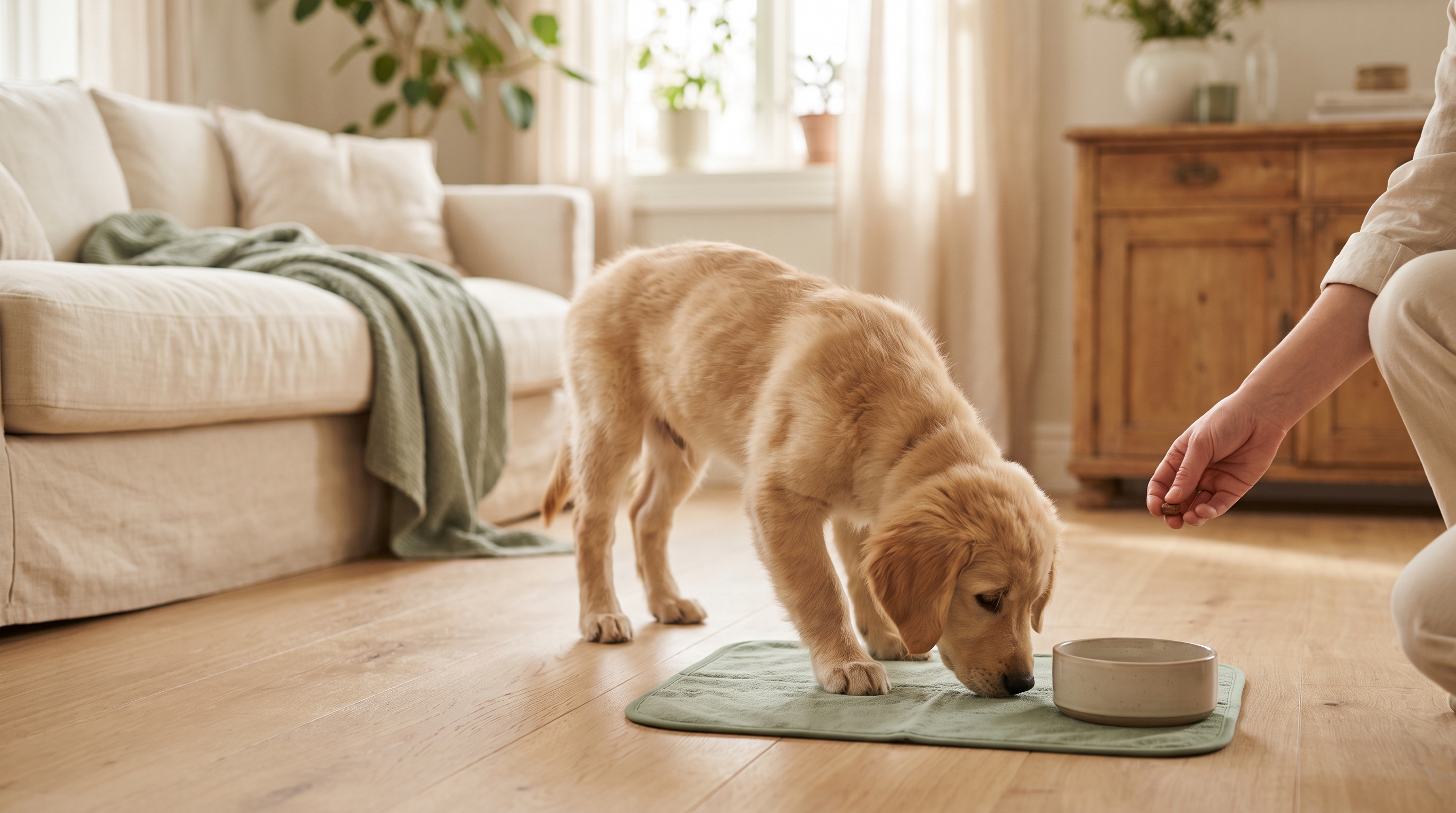
So you’ve got a puppy, a roll of paper towels, and a growing suspicion that your floors will never be the same. Take a breath. You can absolutely do this.
Here’s the short version: to potty train a puppy, take them outside often, reward them the second they go in the right spot, watch them closely indoors, and keep a steady daily routine. That’s the whole game. Do those four things consistently and your puppy will learn. Most puppies take about 4 to 6 months to get fully reliable, so patience is part of the plan.
The rest of this guide breaks down exactly how to do each piece, plus how to handle the accidents (there will be accidents) without losing your mind or your carpet.
First, a Little Perspective
What you’re doing is kind of amazing when you think about it. You’re teaching a completely different species an arbitrary human rule: go here, not there.
We don’t even start potty training human kids until they’re around 1.5 to 2.5 years old, and we expect that to take months. Yet we ask a baby animal to figure it out in weeks. So if it feels hard, that’s because it genuinely is a big ask.
That reframe matters for one reason: accidents are not your puppy being bad. They’re a normal part of learning. Your puppy isn’t stubborn or spiteful. They just don’t have the bladder control or the understanding yet. Both come with time.
House training is worth doing well, too. According to Level Up Dog Training, house-training problems are the number two behavioral reason dogs get surrendered to shelters in the US, second only to aggression. Getting this right keeps floors clean, but more importantly, it keeps dogs in their homes.
A Safety Note Before You Step Outside
Young puppies aren’t fully protected against disease yet. Their vaccine series (the parvo/DHPP shots) usually isn’t complete until around 16 weeks of age. Until your vet gives the all-clear, your puppy can pick up parvovirus and other serious illnesses from ground where other dogs have been. Parvo is nasty, it’s common, and it can be deadly for a young puppy.
So here’s the rule for the early weeks:
- Use a private, low-traffic potty spot, like your own fenced yard or a patch that other dogs don’t use.
- Skip dog parks, sidewalks, pet store entrances, and rest stops until your vet confirms vaccinations are finished.
- Avoid areas where unknown dogs gather. The virus can live in soil and on surfaces for a long time.
This doesn’t mean keep your puppy locked inside. Frequent potty trips are still the plan. Just be picky about where those trips happen until your puppy is fully covered. When in doubt, ask your vet what’s safe in your area.
Why Start Potty Training Early
The AKC calls house training one of the most important first skills to teach a new puppy. Early, gentle training builds habits that last.
Newport Veterinary Hospital lays out the payoff nicely. Starting early:
- Builds trust and communication between you and your puppy
- Prevents behavior problems tied to confusion or anxiety
- Cuts down on indoor accidents and endless cleanups
- Sets the foundation for other routines like crate training and feeding schedules
Potty training doubles as the first real conversation you and your puppy have: it teaches them that you’re predictable and worth listening to.
Step 1: Build a Predictable Routine
Puppies thrive on structure. A steady schedule is the single biggest thing that speeds up potty training, because it makes potty time predictable for both of you.
What goes in on a schedule comes out on a schedule. Feed your puppy at the same times each day and their bathroom needs get a lot easier to guess.
The “one hour per month” rule
The classic guideline is simple. A puppy can usually hold their bladder for about one hour per month of age during the day.
So:
- A 2-month-old (8 weeks) can hold it about 2 hours
- A 3-month-old, about 3 hours
- A 4-month-old, about 4 hours
This is a ceiling, not a target. Don’t wait the full stretch just because you can. Younger puppies need more frequent breaks, and small breeds have smaller bladders, so they often need to go even more often than the rule suggests.
One important note: this daytime rule doesn’t apply the same way overnight. Puppies asleep can usually hold it longer than the daytime math implies. But a very young puppy will still likely need at least one middle-of-the-night trip outside. Sorry.
Take your puppy out at these times
On top of the timed breaks, always take your puppy out (to that safe, low-traffic spot we talked about):
- First thing in the morning, right after they wake up
- After every meal (that full belly gets things moving fast)
- After naps
- After play sessions and excitement
- Before bed
- Right after coming out of the crate
Yes, that’s a lot of trips outside. That’s normal for the early weeks. The frequency drops as your puppy grows and their bladder catches up.
Step 2: Reward the Right Behavior
This is where a lot of new owners go wrong. You catch more flies with cheese than with a scolding.
Every time your puppy potties in the right spot, praise them and give a treat immediately. Not five minutes later back inside. Right there, right then, while they’re still standing on the grass feeling accomplished.
Timing is everything. Puppies live in the moment. If the reward comes even a minute late, they won’t connect it to the potty. Keep tiny treats in your pocket or by the door so you’re always ready.
Positive reinforcement works better than punishment: reputable trainers and vets consistently recommend it. Reward-based training teaches your puppy what you do want, which is far more useful than trying to teach them everything you don’t.
You can even add a cue word. Pick a short phrase like “go potty” and say it calmly while they’re going. Over time, many puppies learn to go on cue, which is a genuine lifesaver on rainy nights and road trips. There’s more on the science of why rewards beat scolding over at Puddle’s guide to gentle training.
Tired of guessing when your puppy needs to go? Puddle predicts the next break from their age and breed.
Get Puddle →Step 3: Supervise Like a Hawk (or Use a Crate)
Every accident that happens indoors is a rep in the wrong direction. Your job is to prevent those reps before they happen.
That means when your puppy is loose in the house, you’re watching. Actively. Not scrolling your phone while they wander off to the dining room.
Confinement is your friend
You can’t watch every second, and you don’t have to. When you can’t supervise, use a crate or a small, puppy-proofed space.
Most dogs don’t like to soil where they sleep, so a properly sized crate helps your puppy learn to hold it. The crate should be just big enough to stand, turn around, and lie down. Too big, and they’ll pick a corner as a bathroom.
A crate isn’t a punishment box, and it shouldn’t feel like one. It’s a cozy den and a training tool. Never use it to scold your puppy.
The umbilical trick
When your puppy is out and about, try clipping their leash to your belt so they stay right beside you. It sounds silly, but it means you’ll notice the pre-potty signals sooner instead of finding a surprise later. You can read more about setting up a low-stress crate routine on the Puddle blog.
⏱️ Puddle predicts the next potty break from your puppy's age and breed, using the AKC "one hour per month of age" rule, trimmed for recent meals and water.
Try Puddle →Step 4: Learn Your Puppy’s “I Gotta Go” Signals
Puppies tell you they need to go. They’re just not very loud about it. Your job is to learn their particular tells before the puddle appears.
Watch for:
- Sudden sniffing of the floor, nose down, quartering around
- Circling or pacing
- Whining or restlessness
- Sneaking off to another room (a classic)
- Heading toward a spot where they’ve had an accident before
- Squatting (this one’s your two-second warning)
The moment you see any of these, scoop them up or cheerfully rush them outside. Don’t wait to see if you’re right. Better ten false alarms than one accident.
Over a week or two, you’ll start to know your puppy’s rhythm well enough that it feels like mind reading, though it’s really just pattern recognition, exactly the kind of thing worth tracking so you can spot it faster.
Step 5: Manage Meals and Water
What goes in shapes what comes out, so a little diet management makes potty training much more predictable.
Feed on a schedule, not free-choice all day. Scheduled meals mean scheduled poops. Most young puppies eat three or four times a day, and they’ll typically need to go outside shortly after each meal.
Keep an eye on water in the evening. You don’t want to restrict water during the day, since a growing puppy needs to stay hydrated. But offering the last drink a little before bedtime (rather than right at lights-out) can mean a drier overnight. Use common sense here, and never leave a puppy thirsty.
Watch what comes out, too. Loose stools or unusually frequent accidents can slow training. Sometimes that’s just too many treats or a diet change. Sometimes it’s a digestive issue or a urinary infection. Which brings us to an important point.
When it’s a vet issue, not a training issue
Most accidents are a training-and-supervision thing. But not always.
Call your vet if your puppy is:
- Straining, dribbling, or going very frequently in tiny amounts
- Having lots of accidents despite a solid routine that was working
- Showing blood in their urine
- Suddenly regressing along with other signs like low energy or appetite changes
Health problems like infections and digestive trouble can genuinely stall potty training. And remember parvo from earlier: if a young, not-yet-vaccinated puppy gets vomiting, diarrhea (especially bloody), or goes off food and energy, call your vet right away. That’s an emergency, not a training hiccup. When in doubt, a quick vet check rules it out. Training can’t fix a medical problem.
Choosing a Method: Outside, Pads, or Both
The AKC notes there are several proven methods, each with pros and cons, and all of them can work. Pick what fits your life.
Direct outdoor training
You take the puppy straight outside to a chosen potty spot every time. This is the fastest route to an outdoor-only dog, since there’s no in-between step to un-teach later.
Downside: it demands a lot of trips outside, day and night, especially early on. Great if you have a yard or a private, ground-floor door. If your only outdoor access is a shared sidewalk or courtyard, hold off on public ground until your puppy is fully vaccinated, and lean on pads in the meantime.
Puppy pads or indoor spot
Here you teach the puppy to go on pads or in a designated indoor area. This can be a real help if you live in an apartment, work away from home, or have a very young puppy who simply can’t hold it long enough to make it outside. It’s also handy during those early weeks before vaccinations are done, when you’re keeping your puppy away from shared outdoor areas.
The tradeoff: pads teach that going indoors is acceptable, which you may later have to undo if you want an outdoor-only dog. Many people use pads early and transition to outside as the puppy’s bladder matures and their shots are complete.
There’s no single “right” answer. The best method is the one you can do consistently. Consistency beats perfection every time.
What to Do When Accidents Happen (Because They Will)
Okay. You turned around for thirty seconds and now there’s a puddle.
If you catch them in the act, interrupt gently: a calm “oop, let’s go outside!” and a quick trip out. If they finish outside, reward like it’s a national holiday. Don’t yell. A loud reaction just teaches your puppy to hide when they need to go.
If you find it after the fact, clean it up and move on. That’s it. Your puppy has zero idea why you’re upset about a puddle from twenty minutes ago. Scolding after the fact only creates fear and confusion.
Never rub their nose in it. This old myth needs to die. It doesn’t teach your puppy anything about house training. It just teaches them to be afraid of you, which makes everything harder.
Clean it like a crime scene
Use an enzyme-based cleaner, not a regular household one. Regular cleaners can leave a scent that your puppy can still smell, and that lingering smell says “bathroom here” to their sensitive nose. Enzyme cleaners break the odor down, so your puppy isn’t drawn back to the same spot.
Handling Regressions
Your puppy was doing great, and now suddenly they’re not. Welcome to the regression, a completely normal bump in the road.
Regressions usually trace back to one of a few things:
- Too much freedom too soon: a puppy who gets full run of the house before they’re ready will have accidents. Shrink their space again.
- A schedule slip: maybe breaks got less frequent as things were going well. Tighten the routine back up.
- Stress or change: a move, new people, a new pet, or a shift in your hours can all rattle a puppy.
- A health issue: as mentioned, if it comes on suddenly and sticks around, loop in your vet.
The fix is almost always the same: go back to basics. More supervision, more frequent breaks, more rewards. Think of it as a quick refresher, not a failure. You’re not starting over. You’re reminding.
How Long Does All This Take?
Expectations matter here: unrealistic ones are how good owners end up feeling like failures.
On average, puppies take 4 to 6 months to fully master potty training, per Newport Veterinary Hospital. Some get there faster with consistent, gentle guidance. Others take longer. Both are normal.
A few things affect the timeline:
- Age: younger puppies need more frequent breaks and more time to develop control.
- Breed and size: small breeds have smaller bladders and often need more outings.
- Routine: consistent schedules speed everything up.
- Health: digestive issues or infections can slow progress.
- Environment: a calm, stable home helps a puppy learn faster.
And please, ignore anyone who says a puppy should be fully trained by 12 weeks. That’s not how puppy bladders work. Real, reliable control develops over months, not days. Expecting perfection from a 3-month-old sets you both up for frustration.
The trend is what matters. Fewer accidents this week than last week means it’s working, even if it’s not finished.
A Simple Day, Start to Finish
Here’s what a solid potty-training day can look like for a young puppy. Adjust the timing to your puppy’s age and your schedule. For a not-yet-vaccinated puppy, all these trips go to your safe, private spot.
- Wake up: straight outside, no detours. Reward the potty.
- Breakfast: then outside again within a short while.
- Play, then nap: outside after play, and again right after the nap.
- Midday breaks: aim for the one-hour-per-month spacing, more often for little ones.
- Dinner: outside after eating.
- Evening wind-down: last drink a bit before bed, then a final trip out right before lights-out.
- Overnight: a young puppy may need one break. Keep it boring and quiet so everyone goes back to sleep.
Notice how much of this is just paying attention to the day’s natural rhythm. Meals, sleep, and play all predict potty needs. Once you see that rhythm, the whole thing gets a lot less mysterious.
Frequently Asked Questions
How long does it take to potty train a puppy? Most puppies take about 4 to 6 months to fully get it, though some learn sooner. Bladder control develops slowly, so don’t expect a young puppy to be reliable overnight.
How often does a puppy need to go out? A good rule of thumb is one hour per month of age during the day. A 3-month-old can usually hold it about 3 hours, plus trips after meals, naps, play, and waking up.
Is it safe to take my unvaccinated puppy outside to potty? Use a private, low-traffic spot like your own yard, and avoid dog parks, sidewalks, and other shared areas until your vet confirms the full vaccine series is done, usually around 16 weeks. Parvovirus and other diseases live in the ground where other dogs have been.
Should I punish my puppy for accidents in the house? No. Punishment, including rubbing their nose in it, teaches fear, not house training. Reward-based methods work better and keep your puppy trusting you.
Why is my potty trained puppy suddenly having accidents again? Regressions happen. It’s often a schedule slip, too much freedom too soon, or stress. But sudden accidents can also signal a health issue, so check with your vet if it continues.
Do puppy pads help or hurt potty training? Pads can help in apartments or with very young puppies, but they teach that going indoors is okay. If your goal is outdoor-only, they can slow things down a little. Many owners use them early and transition outside as the puppy grows.
Track It With Puddle
Potty training comes down to timing, and timing is exactly what’s easy to lose track of at 6am on three hours of sleep. Puddle does the math for you: it predicts your puppy’s next break from their age and breed using the one-hour-per-month rule, trims it based on recent meals and water, and shows a live countdown right on your Today screen and a Home Screen widget. Log every pee, poop, accident, and meal in one tap, and let the app remind you before the next puddle instead of after. It’s free for one puppy with full predictions and iCloud sync, and Pro is a one-time $6.99 with no subscription.