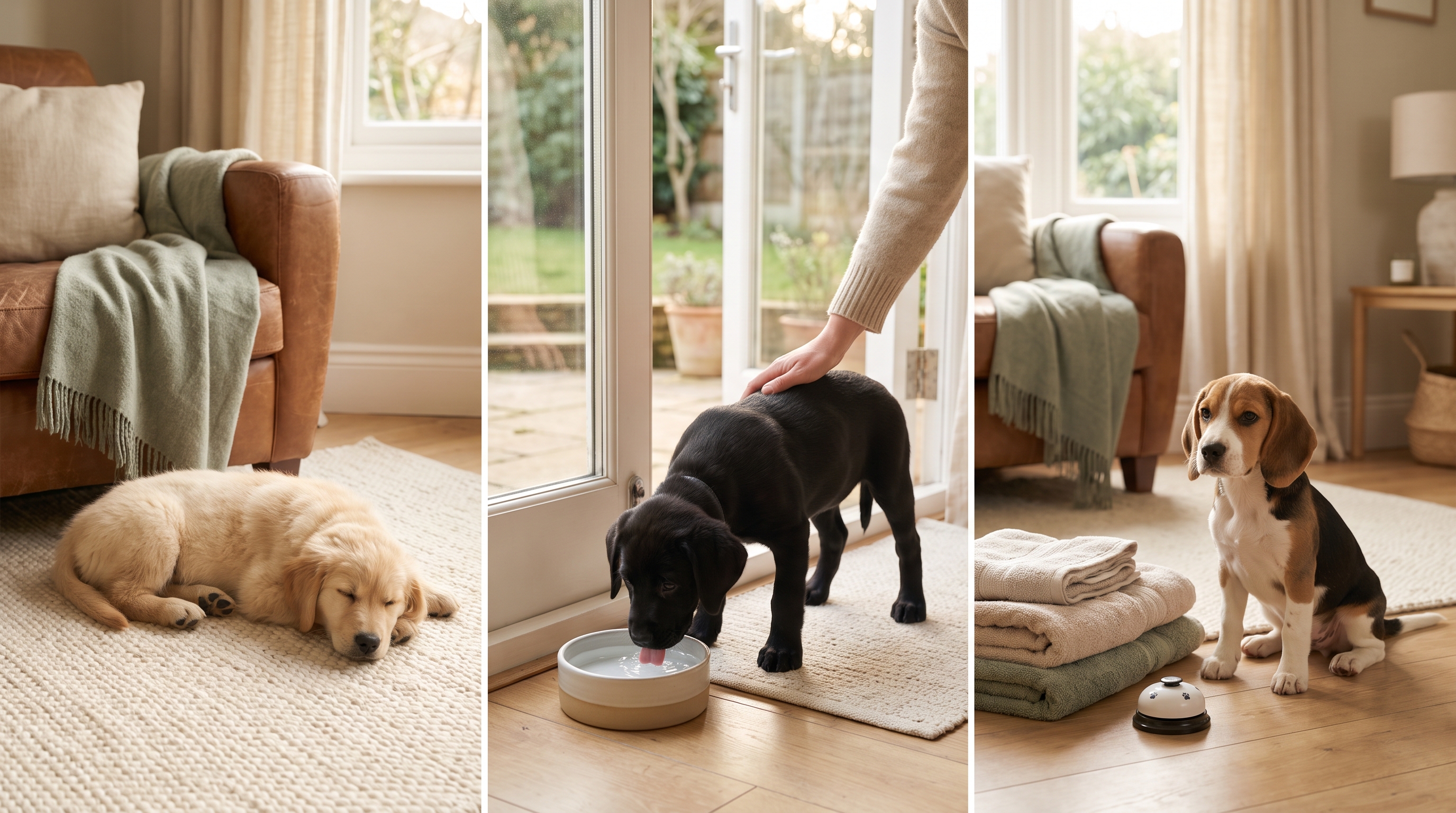
If you’re staring down a new puppy and a roll of paper towels, here’s the short answer: a good puppy potty training schedule is built around two things. Your puppy’s age (which sets how long they can physically hold it) and the daily moments that naturally make puppies need to go, like waking up, eating, napping, and playing.
Get those two things lined up, and accidents drop fast. Below is the schedule, plus the full how to potty train a puppy rundown if you want the fundamentals alongside it.
How Often Puppies Really Need to Go
Puppies aren’t being difficult when they need to go every hour or two. Their bladders are just tiny, and bladder control takes months to develop.
A widely used rule of thumb: puppies can hold their bladder about one hour for every month of age, plus one. So a 2-month-old puppy tops out around 3 hours max. The vets at Sploot Vets describe this as an upper limit rather than a target, and note that realistic full potty training takes around 4 to 6 months, not a matter of days.
That’s a ceiling, not a goal. Think of it as “the most this puppy could possibly hold,” not “how long I should wait.” In practice, you’ll want to offer breaks well before that limit, especially in the first few weeks home.
Applying that same formula as your puppy grows gives you a rough sense of how the ceiling shifts:
- 8 to 10 weeks old: hold times are very short. Bladder control is just getting started, so plan on frequent breaks even more often than the formula’s own ceiling would suggest.
- 3 months old: around 4 hours max between breaks.
- 4 months old: around 5 hours max.
- 5 months old: around 6 hours max.
- 6 months and up: around 7 hours max, though every dog is different.
Again, these are upper limits, not schedules you should build your whole day around. A puppy who can hold it for 4 hours will still have far fewer accidents if you take them out every 90 minutes or so during the busiest parts of the day.
The Daily Triggers Every Schedule Should Include
Age tells you the outer limit. But puppies also need to go at predictable moments in their day, regardless of the clock. Build your schedule around these triggers and you’ll catch most bathroom needs before they become messes:
- First thing in the morning. Straight out of the crate, before anything else.
- After every meal. Eating kicks the digestive system into gear fast, so a bathroom trip often follows close behind.
- After naps. Puppies sleep hard and then wake up needing to go immediately.
- After play sessions. Excitement and movement both trigger the urge to go.
- Right before bedtime. One last chance to empty out before a long stretch of sleep.
If you only remember one thing from this whole guide, remember this list. It matters more than any clock-based interval, because a puppy’s body responds to these events pretty reliably. Our companion post on how to potty train a puppy walks through how to read these signals in the moment, which pairs well with the schedule here.
Building Your Puppy’s Potty Schedule
Now let’s put it together. A basic day for a young puppy (around 8 to 12 weeks) might look something like this, in order rather than on a fixed clock:
- Wake up: straight outside, no detours.
- Breakfast, then outside again shortly after.
- Play or training session, then outside.
- Nap, then outside the moment they wake.
- Lunch, then outside.
- Afternoon play, then outside.
- Dinner, then outside.
- Evening wind-down, with one more break before bed.
- Overnight break if needed (more on this below).
That’s a lot of trips outside. It’s supposed to be. These early weeks aren’t only about bathroom habits, either. They overlap with a major socialization window, the same stretch of time animal welfare groups like the SPCA point to in guides like their “Rule of Sevens” for early puppy development. A steady potty routine now does double duty: fewer accidents today, and one less thing to juggle while you’re also getting your puppy out to meet new people, sounds, and surfaces.
As your puppy grows and shows they can hold it longer, you stretch the gaps. But keep the trigger list (wake, meals, naps, play, bedtime) as the backbone no matter their age.
Tired of guessing when your puppy needs to go? Puddle predicts the next break from their age and breed.
Get Puddle →Overnight Potty Schedule
Nighttime is its own animal. The good news: the daytime “hour per month” rule doesn’t apply quite as strictly overnight. Puppies typically hold it longer while sleeping, since there’s no eating, drinking, or running around to trigger the urge.
That said, very young puppies usually still need at least one overnight bathroom break. A crate helps a lot here. Riverbend Veterinary PetCare Hospital’s pre-training checklist calls for a crate that’s sized just right for your puppy, not oversized. You’ll often hear that a good fit gives a puppy just enough room to stand up, turn around, and lie down without a lot to spare, which is a reasonable way to think about sizing, though the right fit varies by breed and by crate. Too much extra space gives a puppy room to potty in one corner and sleep in another, which defeats the purpose.
A practical overnight approach:
- Take your puppy out right before you go to bed, even if they don’t seem to need it.
- Set an alarm for one middle-of-the-night break if your puppy is still very young or has been waking and whining in the crate.
- Go straight out and straight back to the crate. Keep it boring: no play, no big greetings, just business and back to bed.
- As your puppy gets older and starts sleeping through without accidents, stretch and eventually drop that middle-of-the-night break.
This is exactly the kind of decision that gets easier with a little help. An app like Puddle tracks your puppy’s age and recent meals and water, and predicts the next likely break so you’re not doing bleary-eyed math about “hour per month plus one” at 2am.
⏱️ Puddle predicts the next potty break from your puppy's age and breed, using the AKC "one hour per month of age" rule, trimmed for recent meals and water.
Try Puddle →What You’ll Need Before You Start
A few basics make the whole schedule easier to run:
- A designated potty spot outside. Pick somewhere reasonably protected from heavy rain and mud, since an unpredictable, unpleasant spot makes your puppy want to rush back inside instead of finishing the job.
- A properly sized crate. Sized for your puppy now, not for the dog they’ll grow into.
- High-value treats. Reserved for potty success, so your puppy quickly connects “going outside” with “good things happen.”
- An enzyme cleaner. Regular cleaners don’t fully remove the scent markers that draw a puppy back to the same indoor spot. Enzyme cleaner does.
- A leash, even for yard breaks. It keeps your puppy focused on the job instead of wandering off to sniff the whole yard.
Getting these ready before day one saves you from scrambling mid-accident, which, if you’ve already had one, you know is not a fun way to start your morning.
Troubleshooting: Accidents and Regressions
Even with a solid schedule, accidents happen. That’s normal, not a sign you’re doing something wrong. A few things worth knowing:
Your puppy is not being spiteful or stubborn. An accident almost always means a schedule, supervision, or developmental gap, not defiance. Puppies don’t have the brain wiring for revenge peeing. If it happens, it’s information: something about the current routine needs adjusting.
Skip the nose-rubbing and scolding. Rubbing a puppy’s nose in an accident, or yelling after the fact, doesn’t teach them not to go inside. It teaches them to be afraid of you, or to hide when they need to go, which makes things worse, not better. Reward-based methods, like treats and praise the moment they go in the right spot, are what speed up learning. Our guide on how to potty train a puppy goes deeper into reward-based technique if you want the full picture.
A regression usually has a cause. If a puppy who was doing great suddenly starts having accidents again, look for what changed. A growth spurt, a new environment, a schedule that slipped, more time alone than usual, or a medical issue can all trigger a regression. It’s rarely “the training stopped working.” Logging breaks and accidents, even loosely in a notebook or an app like Puddle, makes it a lot easier to spot exactly when and why a regression started.
Know when to call the vet. Sudden frequent accidents, straining, blood in urine, or unusual urgency aren’t training problems, they’re medical red flags. Conditions like UTIs or digestive issues can look like a potty training failure when the cause is medical. When in doubt, a quick vet check rules out the physical stuff so you can focus on training the behavior.
How Long Until Your Puppy Is Fully Potty Trained?
Realistically, full potty training takes around 4 to 6 months. Some puppies get there faster, some take a bit longer, and that’s all within normal.
A strong first week of consistent routine, like the kind this schedule sets up, gives you a real head start. But full potty training isn’t a 7-day finish line. It’s closer to a season.
That’s good news. It means the goal for week one isn’t perfection, it’s building the habit loop: puppy feels the urge, goes to the right spot, gets rewarded. Do that consistently and the rest follows.
Frequently Asked Questions
What is the best potty training schedule for a puppy?
A good schedule combines your puppy’s age-based bladder limit (about one hour per month of age, plus one) with the daily triggers that make puppies need to go: waking up, eating, napping, playing, and bedtime.
How many times a day should I take my puppy out to potty?
There’s no single magic number. It depends on your puppy’s age and how many meals, naps, and play sessions fill their day. Build breaks around those triggers and you’ll naturally end up with frequent trips outside, especially under about 3 months old.
Can a puppy be fully potty trained in 7 days?
You can build a strong foundation and cut down accidents significantly in a week. Full, reliable potty training realistically takes about 4 to 6 months.
Does the one-hour-per-month rule apply overnight too?
Not exactly. Puppies usually hold it longer overnight since they’re sleeping instead of eating, drinking, and moving. Very young puppies still typically need at least one overnight break.
Why is my puppy still having accidents even with a schedule?
Accidents almost always point to a schedule that needs adjusting, like breaks spaced too far apart or too much unsupervised freedom, rather than stubbornness. Frequent or sudden accidents are worth a vet check to rule out a medical cause.
Track It With Puddle
A schedule only works if you can keep up with it, especially during the sleep-deprived first weeks. Puddle takes your puppy’s age and breed, applies the “hour per month of age” guideline, and trims it based on recent meals and water, then shows a live countdown to the next likely break right on your Today screen. Logging a pee, poop, accident, meal, or water is one tap, so the schedule builds itself instead of living in your head. It’s free for one puppy with full predictions and iCloud sync, and Pro adds a Home Screen widget plus an accident heatmap for a one-time $6.99 payment instead of a subscription.